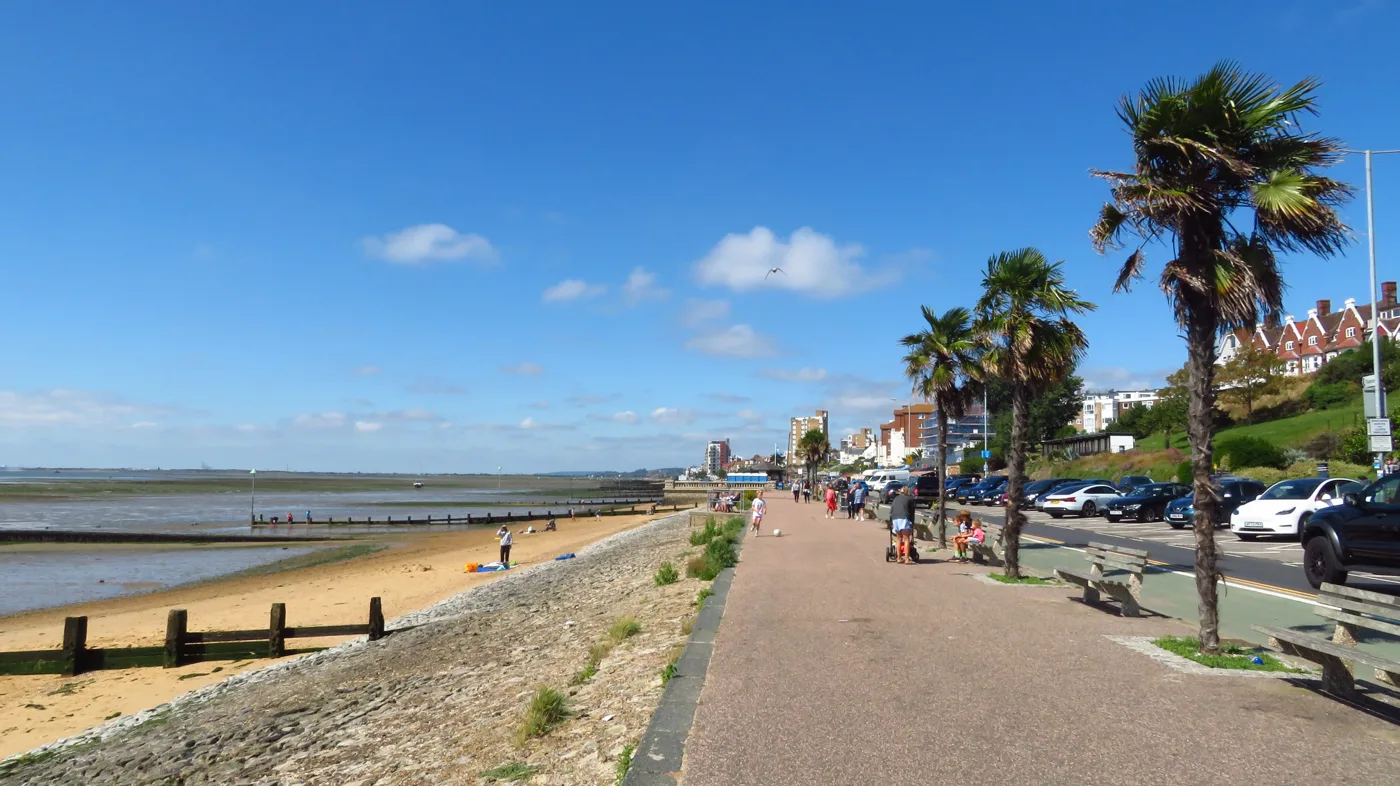

Six coastguards walked out across the mud to a former RNLI Tyne class lifeboat stuck 1km west of Southend Pier. The two aboard sat out a 5.30m ebb.
Six HM Coastguard officers walked out across the mud off Southend on Thursday 10 September to a boat aground about a kilometre west of Southend Pier. Two people were on board. Nobody was hurt.
The vessel was a former RNLI Tyne class lifeboat, which is why the member of the public who called it in described a lifeboat stuck on the mudflats.
The account comes from HM Coastguard Southend-on-Sea, which published it on the team’s own Facebook page and which the BBC and the Echo both carried. A spokesperson said:
“Luckily no-one was injured and the crew were well within the inner channel marker buoys, but unfortunately the tide had turned quicker than expected so they found themselves aground.”
The caller had seen the boat stop suddenly. Six officers put on personal flotation devices and crossed the mud to reach it. They checked that the two people aboard were safe, had provisions and could stay on the boat until the next high water. Then they went back to shore and were stood down.
“We headed back to the station, washed our boots and overalls down and we’re ready for service again.”
A kilometre west of the pier puts the boat off Western Esplanade, on the stretch of foreshore that empties out to the low water channel every tide.
Six officers is most of the team. HM Coastguard’s own profile of the Southend-on-Sea Coastguard Rescue Team, published in August 2024, describes it as five Coastguard Rescue Officers, a Deputy Station Officer and a Station Officer, covering around 70 miles of coastline and Thames Estuary inlets from Benfleet to Battlesbridge. They are volunteers.
The water left Southend 5.30m in under seven hours
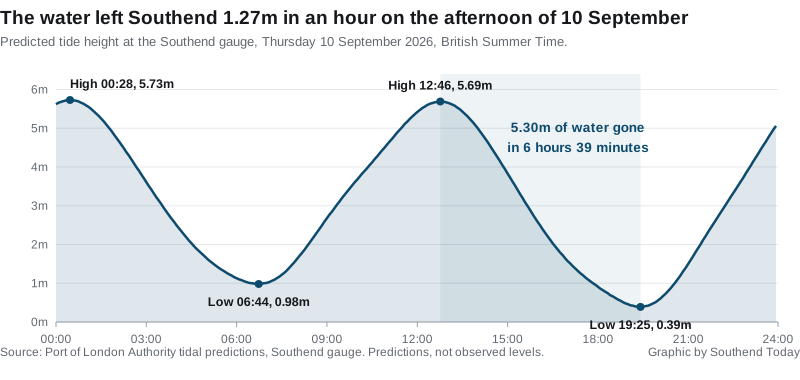
We pulled the Port of London Authority’s tidal predictions for its Southend gauge for Thursday 10 September. Every time below is British Summer Time, and every height is metres above chart datum.
- high water 00:28, 5.73m
- low water 06:44, 0.98m
- high water 12:46, 5.69m
- low water 19:25, 0.39m
Between the afternoon high and the evening low, the predicted level fell 5.30m. Working through the PLA’s minute by minute figures, the fastest hour was 14:47 to 15:47, when the water dropped 1.27m. By 17:00 there was 1.57m showing on the gauge, and by 18:00 there was 0.91m.
The next high water was 01:15 on Friday morning, at 5.92m. That is the wait a boat aground on the evening ebb is looking at.
Thursday was also the day before a new moon, which fell at 03:27 on Friday 11 September. The PLA defines spring tides as “the tides of increased range occurring near the times of full moon and new moon”, when highs are higher and lows are lower than average. The range at Southend has widened since the grounding: Saturday’s afternoon high of 5.96m is followed by a low of 0.31m.
Predictions are not measurements. The PLA’s own note is that predicted levels assume average weather, and surges can push the real level well above or below them.
What a Tyne class lifeboat is
The RNLI’s own record explains the orange and black hull the caller saw.
- the Tyne was the RNLI’s first fast slipway boat, launched in 1982
- FBM Marine at Cowes on the Isle of Wight built 40 of them, and production ended in 1990
- the first, City of London, was named on 1 November 1982 and went on service at Selsey a year later
- it had a steel hull and fully protected propellers, built for the stresses of a slipway launch
- top speed was 18 knots, which is why faster classes replaced it
The class was designed to launch from slipways or to lie afloat in shallow water, which is the same estuary problem Southend has. The last one in service, Annie Blaker at Wicklow, was officially retired on 5 April 2019 after 30 years at the station. The RNLI said she was sold privately and went to Portishead.
Southend is one of four RNLI stations with a hovercraft
The mud here is the reason. The RNLI keeps inshore rescue hovercraft at only four stations in the UK: Hoylake, Hunstanton, Morecambe and Southend. They are for ground a boat cannot reach and a vehicle would sink into.
Southend-on-Sea Lifeboat Station has two boathouses, one at each end of the pier. One holds a B class and a D class inshore lifeboat. The other holds a D class and the hovercraft.
No lifeboat was needed on Thursday. Checked on Saturday 12 September, the station’s published list of recent launches carries nothing for 10 September, and the most recent launch it shows is 3.58pm on Sunday 6 September.
What it means for you
The tide here does not creep, it leaves. The figures above are one ordinary Thursday. If you are taking a boat out, or walking out to the water, the fall is fastest in the middle of the ebb. On Thursday that was two to three hours after high water.
Tide times at Southend for the rest of the weekend, from the PLA’s predictions, in British Summer Time:
| Day | High water | Low water | High water | Low water |
|---|---|---|---|---|
| Saturday 12 September | 01:56, 6.01m | 08:10, 0.77m | 14:06, 5.96m | 20:49, 0.31m |
| Sunday 13 September | 02:34, 6.01m | 08:48, 0.77m | 14:42, 5.99m | 21:24, 0.43m |
| Monday 14 September | 03:10, 5.95m | 09:21, 0.83m | 15:17, 5.94m | 21:51, 0.61m |
If you see someone in trouble on the water or on the mud, call 999 and ask for the coastguard. That is the instruction on the RNLI’s own Southend station page, which asks people not to contact the station directly because it delays the response.
If you are aground and safe, staying put is usually the advice. The two people on Thursday were told to wait for the tide, and the officers checked they had what they needed first.
Planning a trip to the seafront this weekend? Our parking in Southend guide has the seafront zone tariffs, which run three hours later than the rest of the city, and our Southend roadworks and travel page has what is closed right now.
Sources
- HM Coastguard Southend-on-Sea, the team’s published account of the callout
- BBC News, Ex-lifeboat gets stuck on mudflats, carrying the coastguard statement
- Echo, Southend coastguard dispatched after ‘lifeboat’ ran aground
- Port of London Authority, Thames tidal predictions, Southend gauge
- Port of London Authority, tidal information and definitions
- RNLI, 1982: The Tyne class lifeboat
- RNLI, End of an era as crowds turn out in Wicklow to bid farewell to the last Tyne
- RNLI, our lifeboat fleet
- RNLI, Southend-on-Sea Lifeboat Station
- HM Coastguard, Meet Your Coastguards: Southend-on-sea Coastguard Rescue Team
Have your say