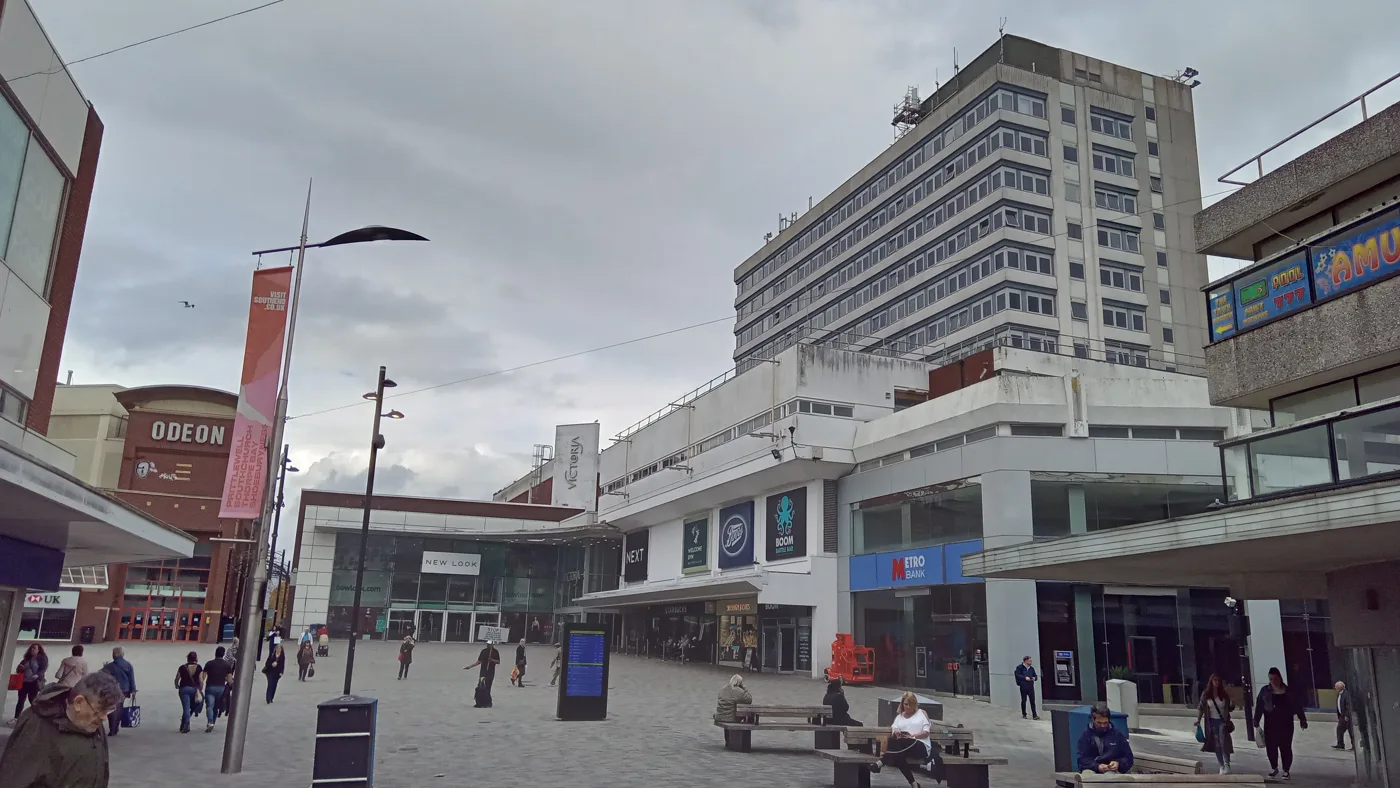

Search the Southend planning portal by full postcode or reference number, and comment inside the three-week window. Why it says too many results, and how to speak.
Southend planning applications are all published on one free public register, and you do not need to be a neighbour, a resident or a registered user to read any of it. Whether it is a loft conversion two doors down, a change of use on the London Road or a scheme for several hundred homes, the drawings, the officer’s reports and the consultation deadline are online from the day the application is validated. This guide covers where to search, how to read the weekly list, how long you get to object, what actually counts as an objection, and the two policy decisions currently reshaping what gets permission in Southend.
Where to search Southend planning applications
The council’s register is an Idox Public Access system:
The council describes it as the service that lets you “search for current and past planning applications and planning appeals, view information, plans and related documents”, and confirms “you can search and view the information freely”, per its view, search and comment page.
Search by street name, postcode or reference number. A Southend reference looks like 26/01262/LAPREM or 26/00845/FUL: the first two digits are the year, the middle block is the running number, and the suffix is the type, with FUL a full application, HOUSE a householder application such as an extension, LBC listed building consent and OUT an outline application. Open an application and the Documents tab holds the drawings and supporting reports, while the summary shows the case officer, the target decision date and the consultation deadline.
The same Public Access system also carries licensing applications, so if you are looking for a new premises licence rather than a planning permission, you are in the right place but need the licensing search.
Read the weekly list instead of waiting for a letter
The single best habit is to stop relying on neighbour notification letters, which only go to properties in the immediate vicinity, and read the weekly list instead. It shows everything registered in a given week across the whole city:
Pick a week beginning date from the dropdown and you get every application validated in it. The portal keeps roughly four months of weeks available at any time, so you can also work backwards to see what has landed near you recently. Filters for ward and for Leigh Town Council are built into the same form, which is useful if you only care about one part of the city.
Set up alerts so the council watches for you
Running that search every week is easy to forget. Register a free account on Public Access and you can save a search and switch on notifications, so the portal emails you when a new matching application is validated. The council lists the benefits of registering as being able to take an active part in decisions and meet the deadline, track the progress of applications, receive notifications and save your searches. If you care about one street, set the search once and let the council’s own system watch it.
What the portal search will and will not accept
The simple search is narrower than it looks, and its refusal message is easy to misread. Tested against the live portal in August 2026:
- A full postcode works. SS1 1EE returned ten applications at that address, newest first.
- A postcode district does not. Type SS1 and you get “Too many results found”, which is the portal declining to render a long list, not a report that nothing exists. The same happens with a bare street name.
- A reference number goes straight to the application. Southend references run as YY/NNNNN/XXX, so 26/00749/FUL is a full application registered in 2026; the letters on the end tell you the application type, and you will also see forms such as /PA for prior approval.
If you hit “too many results”, narrow rather than give up: add the house number, use the full postcode, or drop into the weekly list instead and read a week at a time.
How long you get to comment
The consultation period in Southend is usually three weeks. That is the council’s own wording: “the planning application process allows you to comment on an application, usually within a consultation period of three weeks.”
The exact deadline for any individual application is shown on its page in Public Access, and in the neighbour letter or site notice where one has been issued. Check the portal rather than counting from the date you heard about it, because the clock starts when the consultation opens, not when the application is submitted.
To comment you have to register on Public Access. There is no anonymous route: the council states that comments received without a name and address are not taken into account.
What happens to your comment, and what counts
Southend handles the privacy of comments differently from many councils, and it is worth understanding before you write.
- Your name and address form part of the statutory planning register, and can be seen by councillors, the applicant and members of the public.
- However, comments are not currently published online through Public Access. They are available on request rather than posted on the website.
- Personal details are stripped: the council removes your telephone number, email address and signature from the comment.
- Comments are passed to the Planning Inspectorate if the application goes to appeal.
The harder part is what to say. A planning decision can only turn on planning merits. Points that carry weight include the effect on neighbours’ light and privacy, highway safety and parking, design and the character of the area, noise, loss of trees or green space, drainage and flooding, and conflict with the council’s own planning policies. Points that carry little or none include the loss of a private view, the effect on your property value, competition with an existing business, and anything about the applicant personally. An objection written in the language of the policies is worth more than ten written in the language of annoyance.
Who decides, and how to speak at committee
Most applications never reach politicians: they are decided by planning officers. The ones that do go to the Planning Committee, which “meets on a Wednesday at 2pm every 4 weeks to consider major and contentious planning applications”, per the council’s Planning Committee page. Dates and papers are published on the council’s democracy system.
Southend operates public participation, which means that if you have objected you can make your case in person to the committee, and the applicant then has a right of reply. There are strict timetables for registering to speak, and the council publishes a guide to commenting on planning applications that sets out the committee procedure. If a scheme matters to you, objecting in writing is what earns you the right to turn up and say so.
One practical warning from the council: Public Access “is occasionally down for maintenance”, so do not leave a comment until the final hours of a deadline.
What is shaping Southend planning decisions right now
Two things happening in 2026 will change what gets permission, and both are more consequential than any single application.
The draft Local Plan and the housing numbers
Southend is preparing a new Local Plan running to 2045, and the housing target is the fight. The council’s draft proposes 14,700 new homes, against a government target of over 28,000, and includes an infrastructure-led new neighbourhood of around 4,900 homes north of the city. The Regulation 19 consultation on the draft was due to begin in September 2026.
The council’s argument for getting a plan adopted is defensive. Cllr Kevin Robinson, cabinet member for planning, property and governance, put it this way when the draft was published on 27 July 2026: “Without an up-to-date Local Plan, government housing targets and speculative development would have a much greater influence over what gets built and where.” The detail is in the council’s announcement of the draft Local Plan, and background sits in the local planning framework.
If you want to influence where new housing goes near you, the Local Plan consultation matters more than objecting to the applications that follow it. We track the plan’s progress, the housing numbers and the city’s biggest live schemes in Southend planning news.
Takeaways near schools
The other change is narrower but will show up in decisions quickly. The council has approved stronger planning controls to restrict new hot food takeaways within 400 metres of schools, a distance chosen to reflect the typical walk to and from the school gates. It came through the Director of Public Health’s annual report, approved by Cabinet on 13 July 2026, which noted that Southend has 219 fast food outlets, above the national average for a population its size, and that 22.7% of Reception children and 33.8% of Year 6 children are overweight or obese. The council set it out in its announcement on takeaway restrictions.
Frequently asked questions
How do I find planning applications in Southend?
Search the council’s Public Access portal at publicaccess.southend.gov.uk/online-applications by address, postcode or reference number. No account is needed to look. The weekly list shows everything validated in a given week across the city.
How long do I have to comment on a Southend planning application?
Usually three weeks from the start of the consultation period. The exact deadline is shown on the application’s own page in Public Access, so check there rather than assuming.
Do I have to register to comment on a Southend planning application?
Yes. Viewing is free and open, but commenting requires a Public Access account, and the council does not take anonymous comments into account.
Are comments on Southend planning applications published online?
No. Your name and address form part of the statutory planning register and can be seen by councillors, the applicant and the public, but the council does not currently publish comments online. Telephone numbers, email addresses and signatures are removed.
Can I speak at the Southend Planning Committee?
Yes, if you have objected. The committee meets on a Wednesday at 2pm every four weeks for major and contentious applications, and operates public participation, with objectors able to make their case in person and the applicant given a right of reply. Registration deadlines are strict.
How many homes does the Southend Local Plan propose?
The draft published in July 2026 proposes 14,700 new homes up to 2045, against a government target of more than 28,000, including around 4,900 in a new neighbourhood north of the city. Regulation 19 consultation was due to open in September 2026.
Sources
- Southend-on-Sea City Council, view, search and comment on planning applications online
- Southend Public Access planning portal and the weekly list of applications
- Southend-on-Sea City Council, Planning Committee and the guide to commenting on planning applications
- Southend-on-Sea City Council, democracy, meetings and agendas
- Southend-on-Sea City Council, draft Local Plan proposes lower housing target and the local planning framework
- Southend-on-Sea City Council, new takeaway outlets to be banned within 400m of school gates
Checked against the council’s planning pages in August 2026. Consultation deadlines and application statuses change daily, so always confirm on Public Access before relying on a date. Our guides to Southend council tax bands and parking in Southend cover the other council services people ask about most.
Have your say