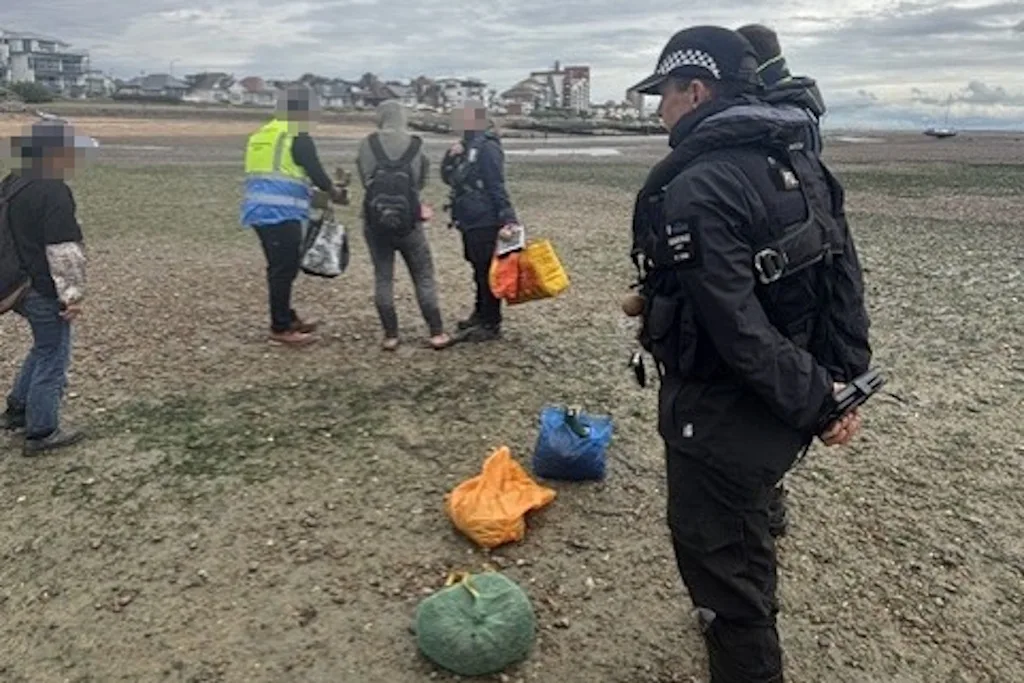

Council officers seized 22kg of mussels, clams and winkles from four gatherers on Chalkwell beach; more than half the clams were under the legal minimum size.
Council officers seized 22kg of shellfish from people gathering on Chalkwell beach earlier this month. More than half the clams taken were below the legal minimum size.
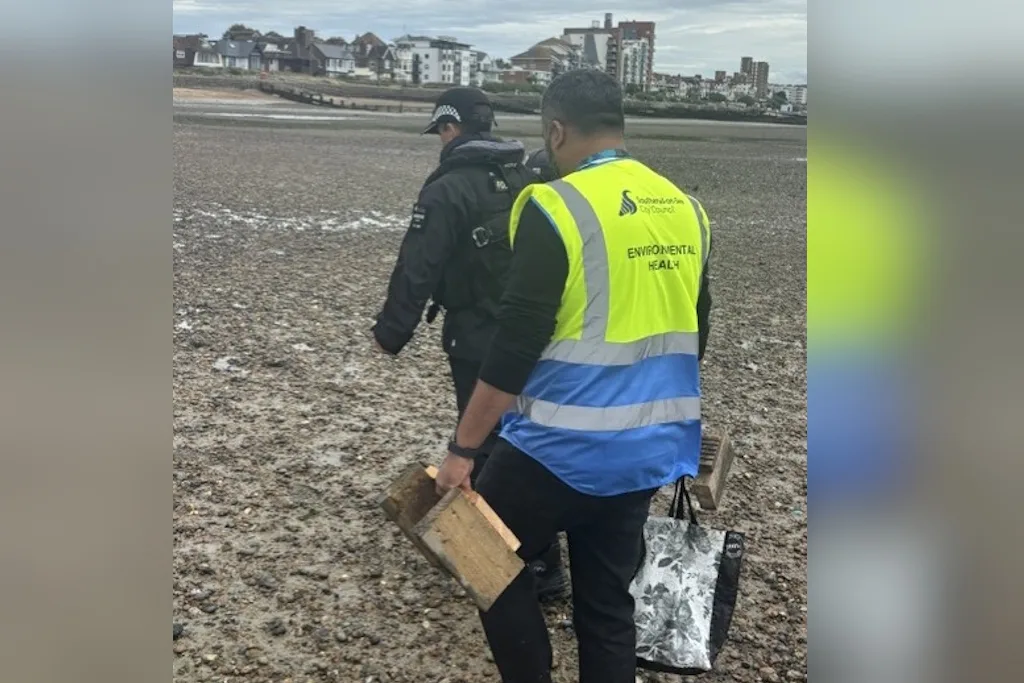
Four people were stopped and spoken to on the foreshore. Officers had gone to check on people reported to be harvesting mussels, clams and periwinkles. Southend City Council’s environmental health officers made the seizure. Essex Police published the details on Monday 28 September (Essex Police).
The force did not give the exact date of the operation, and it has not said whether anyone will be prosecuted.
Three agencies on one beach
The operation brought together three organisations, each with its own powers:
- Kent and Essex Inshore Fisheries and Conservation Authority (IFCA) monitors the shellfish beds and enforces catch size limits
- Southend City Council’s environmental health team is responsible for public health and food safety, and seized the shellfish
- Essex Police’s Marine Unit supported both
Hayden Hurst, the IFCA’s principal compliance and enforcement officer, said the police support let officers verify identities. He said police fingerprint scanners were “particularly valuable”. They allowed officers “to progress enforcement action in relation to repeat offenders who had previously provided false details” (Essex Police).
That is the most telling line in the statement. It means some of the people gathering on Southend’s foreshore have been stopped before, and gave false names when they were.
Why picking shellfish here is not allowed
PC Craig Stocker of the Marine Unit set out the rules in the force’s statement:
“Harvesting shellfish without a permit or a licence is illegal. The rules are there to protect public health because shellfish which are not properly harvested may be unsafe to eat because they can be contaminated with raw sewage and other toxins.”
He added that it is also illegal to take undersized shellfish. The amount that can be taken is restricted too, so that no one species becomes endangered.
The council’s own guidance goes further. It says live shellfish from the Southend foreshore are collected by registered operators and taken to council-approved depuration centres. There they go through a lengthy cleaning process to remove impurities and harmful bacteria before they are sold (Southend-on-Sea City Council).
Shellfish taken from unclassified or prohibited beds, or without a valid registration document, can be seized. The council can then seek a magistrates’ court order to destroy them, and the gatherer pays the costs. Breaking the food hygiene rules on organised harvesting is a criminal offence carrying an unlimited fine, up to two years in prison, or both, according to the same page.
The London Port Health Authority opens, closes and classifies the Thames shellfish harvesting areas from its sampling, and issues notices when it closes a site (London Port Health Authority).
The minimum sizes
The Essex Police statement does not say which species of clam was undersized. The IFCA’s byelaw sets these minimum sizes for the clams most likely to be found in the district (Kent and Essex IFCA):
| Species | Minimum size |
|---|---|
| Short-necked (Manila) clam | 35mm |
| Grooved carpetshell | 40mm |
| Carpetshell | 38mm |
| Hard clam | 60mm |
| Razor clam | 100mm |
Anything below those sizes must be returned to the sea immediately.
A shellfish town
Councillor Irene Ferguson, the council’s Cabinet Member for Housing and Preventing Homelessness, said illegal harvesting “puts public health at risk, damages our local seafood industry, and harms the coastal environment”. She added: “Southend has a long-standing shellfish heritage and we are committed to protecting it.”
That heritage is a working industry, not just history. The council’s case for the Leigh Port works is that doing nothing would “jeopardise the long-term viability of the cockle industry in old Leigh”.
What it means for you
- Do not pick shellfish on Southend’s beaches to eat. The council’s advice is to buy from a reputable food business instead. That shellfish has been through depuration and is safe.
- If you see what looks like organised gathering or oyster shucking on the seafront, report it through the council’s unauthorised shellfish picking form.
- If it is happening now, the council also asks you to call 01702 215000 and ask for the food safety team, which will try to send an officer.
- The IFCA can be reached on 01843 585310 about fisheries matters such as undersized catches (Kent and Essex IFCA).
Have your say